By Natalie Romano
There were none of the usual sounds of celebration.
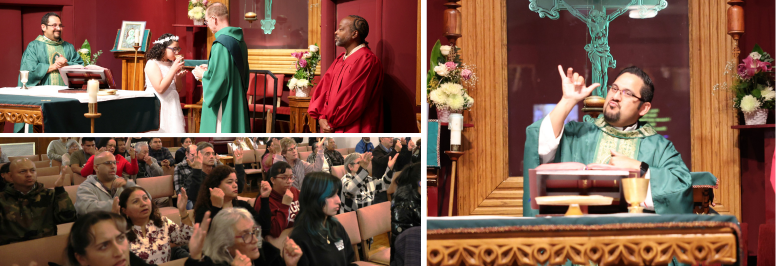
Yet the joy inside the quiet church was palpable when parishioners waved their hands high in the air after Violette Toscano, who is deaf, made her First Holy Communion.
The ten year old, wearing a white lace dress and floral crown, reacted to the “deaf applause” with a shy smile. Violette traveled with her family all the way from Barstow to Los Angeles so she could receive her Sacrament at Holy Angels parish, the only designated deaf Catholic Church in Southern California.
Also present for the February 15 Mass; a band of clergymen united in their mission to expand Deaf Catholic Ministry.
“I have a heart for deaf ministry, deaf culture. It’s just beautiful,” says Father Bryant Rivas, Parochial Vicar of St. Anthony Catholic Church, San Jacinto. “Yet many deaf people don’t go to Mass, don’t have their Sacraments, don’t get married in the Church. But why? Because we never offer it to them.”
The clergy, all proficient in American Sign Language (ASL) - some with hearing loss, are Deacon Tomas Garcia Ed.D. and Deacon David Rose from Holy Angels in the Archdiocese of Los Angeles, Father Steve Correz and Father Scott Allen with the Deaf Ministry of the Diocese of Orange and Fr. Rivas, the only ASL proficient priest in the Diocese of San Bernardino.
Working in a newly formed partnership, the group wants to raise awareness about the needs of the deaf community, increase the number of priests who know ASL and provide more faith building opportunities for Deaf Catholics at both a diocesan and regional level.
In the Diocese of San Bernardino there is no formal Deaf Ministry but parishes like St. Anthony, St. Catherine of Alexandria in Riverside, St. Martha in Murrieta and Our Lady of the Desert in Apple Valley have created their own and regularly offer Mass with volunteer interpreters.
But no matter the diocese, the clergy members believe deaf Catholics are generally underserved and too often find themselves isolated in society and church.
“When we think about the Body of Christ, one of the most important ideas is the sense of belonging,” says Dcn. Garcia, who is profoundly deaf. “While [ASL interpreters] allow Deaf Catholics to follow the liturgy, participation often ends when the interpreter leaves.”
Fr. Allen, whose connection to the deaf started with an ASL class in college, says the Catholic Church needs to catch up with its Protestant counterparts.
“Sadly, we’re 30 years behind in terms of technology and understanding the community,” he explained. “This is a group of people that need God, that need Jesus Christ in their life…need an intimate place for sharing and being vulnerable with one another on a frequent basis.”
To get a greater understanding, Fr. Rivas visited Holy Angels, established nearly 30 years ago near downtown Los Angeles by then Archbishop Roger Mahony. Fr. Rivas recalls how he “had never seen so many deaf Catholics in one place” and appreciates how everything was designed with the deaf in mind. ASL is the primary language there but is translated for hearing parishioners. Objects on the ambo are shorter so there’s an unobstructed view while matte burgundy walls limit glare. A screen above the altar further assists with visual cues and videos. Other special touches include giving parishioners the opportunity to publicly offer their intentions during Prayers of the Faithful and music is accompanied by a vibrating drum.
Dcn. Rose, who is hard of hearing, has served at Holy Angels for 23 years. This inclusivity is why he calls the parish “Deaf Catholic Mecca.”
“We can be ourselves! We’re very proud of our own language. We’re very proud of our own culture and we’re especially proud to have our own church,” stressed Dcn. Rose as he pressed his fist to his heart. “The one and only.”
Of celebrating the Mass on Violette’s big day, Fr. Rivas says he was a little nervous at first then enjoyed the experience of not speaking at all versus his usual “SimCom” which is simultaneously speaking and signing. He uses expressive facial and hand gestures to convey feeling in the absence of tone or volume. Through the years, he’s coined a few moves.
“At the beginning of the prayer, I always tap,” described Fr. Rivas, who was ordained in 2023. “It’s like I’m trying to get God’s attention, ‘Look at us.’ Also, it’s not always clear to deaf people when they are supposed to respond so I prompt them with ‘copy me’ cues.”
A small group of St. Anthony parishioners also attended the February Mass for the unique experience of an all deaf church, an experience they would like to have closer to home.
“Fr. Rivas shows care, compassion and love towards my daughter and our family,” said Edith Arana, whose daughter is deaf. “There’s not much community or spaces specifically for deaf kids. I would like more fathers and deacons to know sign language and support the deaf.”
Fr. Rivas’s passion stems from his friendship with Gerald L. Sullivan, a deaf Catholic he met as a seminarian. Seeing a need, the enthusiastic seminarian helped arrange for Sullivan to teach ASL at St. Junipero Serra House of Formation in Grand Terrace. From then on, Fr. Rivas’s path was set.
Nowadays at St. Anthony, he signs Mass at least once a week and teaches an ASL class for new volunteers and families with a deaf loved one, since most deaf children are born to hearing parents. He also developed a hybrid class where Spanish speakers learn words in both English and ASL.
Volunteer Robin Navarro learned ASL because she has a deaf granddaughter. The long-time parishioner says she never thought she would share her skill with others, but Fr. Rivas had different ideas.
“It was his first Sunday and knowing that he knew ASL, I went up to him and signed, “Hi, my name is Robin and it’s nice to meet you, welcome,” recounted Navarro. “He looks at me and goes ‘See me after Mass.’ Next thing you know, I’m in Deaf Ministry.”
A lack of volunteers is a common concern expressed by lay ministers in the field. Anita Metroka is one of the ASL Coordinators at St. Catherine’s and after 40 years of signing Mass, her shoulders are sore.
“We need new blood,” said Metroka, a retired teacher from the California School of the Deaf, Riverside. “I think [younger generations] could bring fresh ideas, the stamina and the willingness to put in the time and effort.”
Recognizing these many gaps, the clergymen are working with their respective bishops seeking more resources for deaf ministry. Dcn. Garcia recently met with Los Angeles Auxiliary Bishop Marc Trudeau and discussed how Holy Angels could expand its reach with online services and mental health training. Fr. Allen, with support from his bishops, is working on a multimillion-dollar endowment to build a larger Deaf Ministry staff. Locally, Fr. Rivas says his ultimate dream is a deaf parish but, in the meantime, he wants to create a system where each vicariate in the diocese offers Mass for the deaf. Bishop Alberto Rojas applauds his efforts.
“It’s a blessing to have someone like him who is willing to do this,” said Bishop Rojas. “It would be good to encourage other priests to learn [ASL]. It’s an important ministry.”
In the near future, the clergymen envision a regional event like a retreat exclusively for Deaf Catholics. As for now, they say working together has sparked a renewed sense of possibility.
“I frequently ask for prayers so that I can continue doing the Lord’s work in the Deaf vineyard,” says Dcn. Garcia. “For me personally, this ministry is both deeply rewarding and a true sense of purpose and it is something I look forward to every day.”
If you would like to get involved with Deaf Ministry, email Fr. Rivas at This email address is being protected from spambots. You need JavaScript enabled to view it..
Natalie Romano is an award-winning freelance writer based in Southern California.