By Elena Macias
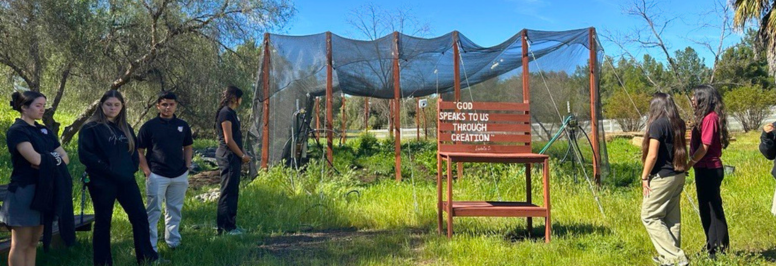
On a brown wooded garden chair in front of St. Jeanne de Lestonnac High School’s Future Farmers of America (FFA) regenerative farm dawns the white-painted words, “God speaks to us through Creation.”
“We treat this soil as part of our home because it is,” said Alexys Bautista, Director of Agriculture Education & FFA at the Temecula Catholic high school. “We base a lot of our farm on Pope Francis’ Laudato Si’ Encyclical Letter and we have this chair to honor Laudato Si’ and really express that this is the foundation of what he said that ‘God speaks to us through creation.’ ”
Ten years ago, +Pope Francis released Laudato Si’, On the Care for Our Common Home. He began the letter, “LAUDATO SI’, mi’ Signore’ – ‘Praise be to you, my Lord.’ In the words of this beautiful canticle, Saint Francis of Assisi reminds us that our common home is like a sister with whom we share our life and a beautiful mother who opens her arms to embrace us. ‘Praise be to you, my Lord, through our Sister, Mother Earth, who sustains and governs us, and who produces various fruit with colored flowers and herbs.’ ”
Now, in 2026, the Universal Church celebrates a Jubilee Year of St. Francis of Assisi, as declared by Pope Leo XIV, on the 800th anniversary of the saint’s death. Like St. Francis of Assisi, FFA students at St. Jeanne de Lestonnac High School are giving praise to the Lord by nurturing the earth through a regenerative farm.
“It really centers us back to the earth,” said FFA student Mary Villa. “But FFA in general was something that I didn’t think that I would ever find interest in. Ultimately, it’s more than just farming and cattle, it’s everything, especially when you root that back into our faith it means so much more to me. Seeing how we can provide for people but also provide for the earth and build a connection with God, there’s really a lot of benefits to it.”
FFA students are currently growing squash, corn and beans on the farm utilizing the indigenous agricultural practice of “The Three Sisters,” where the three crops are planted and protect and nourish each other in different ways as they grow. The students will grow different crops from season to season with one of their goals to provide a local source of food for their annual Farm to Table FFA Chapter dinner.
“What makes it special is that we try to source our food from either local markets or our regenerative farm. In the past we’ve had spaghetti squash with zucchini grown from our regenerative farm,” FFA student Yamila Ibarra said. “We discuss the history of our regenerative farm and the practices that we use that are helping with soil degradation and reducing climate change and improving the soil health, not only here but trying to encourage people to learn more about that and growing their agricultural literacy.”
The regenerative farm serves as a center for holistic ecological education and aims to generate food to feed the community in need. Campus green waste gets transformed into nutrient-rich compost that goes back to feeding the microbiology in the soil that feeds the plants on the farm. The group is currently working toward a goal of partnering with local wineries to grow wine grapes on the farm. Another goal is to have fruit trees planted on the farm, so that harvested fruit could be sold during farmers markets in the community, where local chefs can purchase locally grown produce. To achieve their goals and nurture the farm, sometimes students volunteer to work on the farm on Saturdays.
“I spent hours on the farm, between my freshman and sophomore year, because I was on the farm team and it was such a rewarding experience. I think I spent like eight hours a day for a month out here,” recalls FFA student Ellie Kiggins. “It’s such a rewarding experience that I would do it again if I had the chance, it’s truly so enriching to be outside even though it’s hot and I totally got a huge farmer’s tan.”
The FFA program also gives students the opportunity to participate in public speaking competitions and agriscience fairs. FFA student Villa took third place in Prepared Public Speaking at the 2026 Southern Region Speaking Finals and will compete in the California FFA State Speaking Finals in April. She picked agricultural and food literacy as her topic.
“A lot of kids or even adults don’t know a lot about where their food comes from,” Villa said, explaining her choice of topic. “Starting from where it’s grown, how it’s handled, to how it’s processed. So, my speech is how it’s important for everybody, even if you’re not in an FFA, just to know where your food came from and how it’s going to affect your body and your life because ultimately that’s something that everybody has in common, we all eat and we all need healthy food.”
After seeing a student actively participating in an FFA program for the first time, Sister Leticia Salazar, ODN, Chancellor of the Diocese of San Bernardino, encouraged St. Jeanne de Lestonnac School President Sister Ernestine Velarde, ODN, to bring it to the school because of its ability to teach the whole student and develop great leadership.
“It just brings the best out of you and the real meaning of leadership because leadership is not only someone that has a big role or a big position,” Sr. Leticia said, “leadership is giving the best of you for the common good.”
St. Jeanne de Lestonnac School is committed to building a Christ-centered community rooted in the Roman Catholic faith and values in order to prepare youth and young adults as leaders at the service of others. This mission can be seen through its FFA students.
“I’m very proud of them,” said Sr. Ernestine. “They’re going to make a difference because they’re rooted in the Lord, that’s the source of growth. [They’re] rooted in God, the source of life.”
Sr. Leticia encourages FFA students to continue their journey of becoming future leaders.
“I would like to invite you to keep growing in this,” she said, speaking to a group of FFA students on March 3. “Find the strength in yourself that is good for society, especially now. We need leadership that is life-giving, like the way of the soil, we need exactly that like St. Francis, St. Jeanne and all the Saints that we know in the Church, and also the saints that we know here among you.”
Elena Macias is the Managing Editor of the Inland Catholic BYTE