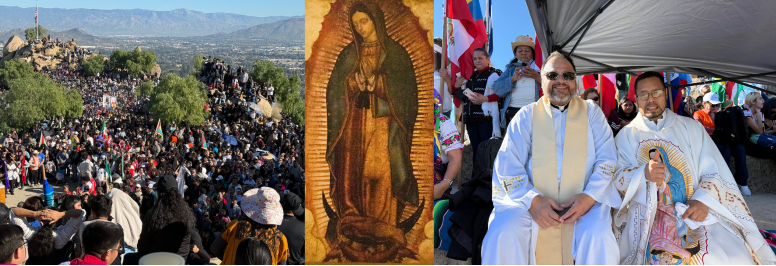
Since the founding of the Diocese of San Bernardino in 1978, the Catholic community has walked in the footsteps of San Juan Diego through great devotion to Our Lady of Guadalupe. Bishop Phillip Straling, founding bishop of the diocese, made the decision that the patroness of the diocese would be Our Lady of Guadalupe, “as a public manifestation of our deep desire to follow Juan Diego’s footsteps with a message of love and salvation.”
This year, our faith communities continued with long held traditions to honor our patroness with various public and private celebrations, displaying their deep love and observance of Our Lady and her feast day, December 12.
Some parishes even get started a little early. On Dec. 6, thousands joined the annual “El Camino de San Juan Diego,” procession from Our Lady of Guadalupe Shrine, Riverside, to the top of Mount Rubidoux, where a special Mass was celebrated by Father Jose Marcos Saavedra, OdeM, Pastor of the Shrine. Beginning on Oct. 28, Sacred Heart Church in Jurupa Valley prayed the 46-star Rosary to Our Lady of Guadalupe, praying the rosary for 46 days straight. Saint Kateri Tekakwitha Church celebrated a pilgrimage on Dec. 7 from the parish’s Beaumont site to its Banning site. Our Lady of Guadalupe Church in San Bernardino held a festival from Dec. 11-14 in honor of the feast day. And many more parishes and schools in the diocese celebrated the feast day of OLG with their own special devotion.
According to an article by former diocesan archivist, Peter Bradley, while reflecting on his early decision to designate Our Lady of Guadalupe as the Diocesan Patroness, Bishop Straling recalled, “a big question before the diocese at the time was our ministry to Hispanics.” In 1981, while celebrating the 450th Anniversary of the appearance of Our Lady of Guadalupe, Bishop Straling stated “It is my prayer that this celebration in honor of Our Lady of Guadalupe may grow each year, so that everyone may know that she is our Patroness.”
Bishop Straling’s prayers were answered as celebrations in honor of Our Lady have grown in size, along with the Hispanic community. According to the U.S. Census Bureau, as of 2023, over 2.5 million Hispanics live in San Bernardino and Riverside Counties. Common elements of the Feast of Our Lady of Guadalupe include Las Mañanitas, dancers, processions, pilgrimages, Eucharistic celebrations, traditional foods, reenactments and more.
“The Lady from Heaven”
Our Lady of Guadalupe appeared to Saint Juan Diego on December 9, 10 and 12, 1531 at Tepeyac Hill in the area of modern-day Mexico City. She identified herself as the Mother of the True God and instructed him to have the bishop build a church on the site. As a sign for the bishop, she left an image of herself imprinted miraculously on his tilma, a poor-quality cactus-cloth. The tilma should have deteriorated within 20-30 years but shows no sign of decay after 494 years.
The Tilma
• The image left on Saint Juan Diego’s tilma is the only true picture of OLG in existence.
• Microscopic examination revealed that there are no brush strokes.
• The stars on her mantle coincide with the constellation in the sky on December 12, 1531.
• She wears a black maternity band signifying she is with child.
• Her eyes contain reflections of the scene with Juan Diego and the bishop that are visible only with modern technology. There are 13 total figures that form two scenes in both eyes.
• A man once tried in 1921 to blow up the image by detonating dynamite in the church, but despite the church practically crumbling around it, the image was unharmed.
After the apparitions, eight million natives of Mexico converted to Catholicism from 1531 to 1538. The tilma has been venerated by millions of people every year, and the image of Our Lady of Guadalupe has become ubiquitous with Mexican culture.