By Naida Castro
A Filipino Catholic tradition during Holy Week is the Pabasa (or Pabasa ng Pasyon) featuring the continuous, rhythmic chanting of the Pasyon, an epic poem narrating the passion, death, and resurrection of Jesus Christ. Pabasa was introduced in the 17th century by Spanish friars as an evangelization tool to teach Christian doctrines to the Filipinos through song. Pabasa merges European biblical narratives with indigenous Filipino pre-colonial traditions of epic singing.
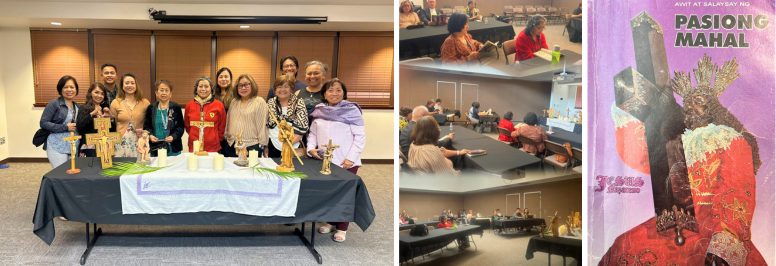
The earliest Tagalog version of the core text is the Pasyong Mahal (see picture) written in 1704 by Gaspar Aquino de Belen. Filipinos transformed a Catholic devotion into their local expression of faith by integrating their musical styles and vocal techniques to chant the core text. Hence, the core text may be chanted in their local dialect such as Kapampangan, Tagalog, Bisayan, etc.
The chanting of the Pabasa became the people’s panata (vow or religious promise) as well as a form of thanksgiving or spiritual petition. Pabasa usually takes place in homes, chapels, and workplaces from Palm Sunday to Good Friday.
What many may not know is that Pasyong Mahal served to inspire the Filipino indigenous resistance movement and revolution against Spain’s occupation in the Philippines.
In 1993 when the Diocesan Filipino Ministry was formed, Filipinos continued their expression of faith, religiosity, and culture. The ministry led by Jessie Cristobal, together with the leadership from St. Peter and Paul Parish, including but not limited to Deacon Santi and Virginia Garospe, Louie+ and Annie David, Emilio Gamalinda+, Ronnie Gamalinda+, and through the Diocesan and Parish leadership that followed during the last 33 years, the chanting of the Pabasa continues. Here in the Diocese, this Filipino Catholic tradition is being practiced in parishes where there is an active Filipino community or ministry.
Naida Castro is a longtime diocesan minister in the Filipino Catholic community.