05/01/2026
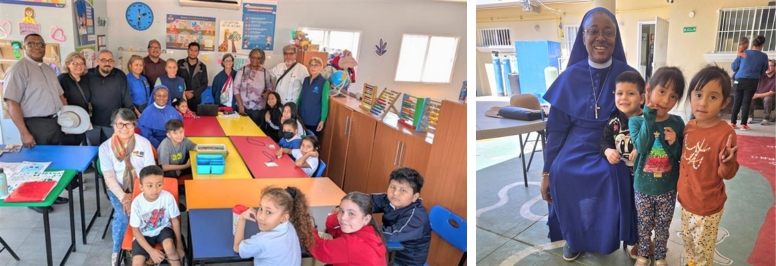
On April 15, delegates from the diocese journeyed to the U.S.-Mexico border at Tijuana to provide outreach services to the “Instituto Madre Asunta,” a shelter owned and managed by the Scalabrinian Missionary Sisters of St. Charles Borromeo for over 30 years.
This shelter helps displaced women and children, providing them housing, medical attention, personal hygiene needs and education.
The outreach service was led by Sister Mary Chilee Okoko, D.M.M.M., Director of the Diocesan Department of Life, Dignity and Justice. Sr. Chilee has led other outreach missions, making three trips to Mexicali in Baja California in recent years, but this was the first trip to the Mexico - U.S. border at Tijuana.
“We saw the wall and on the U.S. side, it was gray, but on the Tijuana side of the wall, the community painted colorful beautiful murals on the wall,” Sr. Chilee noted.
Joining Sr. Chilee on the diocesan delegation were Deacon Daniel Ezekwe, Deacon Jose Rene Quiroz and his wife, Veronica, Deacon David Okonkwo, Deacon Fernando Heredia and his wife, Regina, Naida Castro and Virginia Balanga from Asian Pacific Islander Ministry, Ifenyinwa Ezeoke and Assumpta Akubilo from the Catholics of African Descent ministry, Wilfredo Aguirre, Associate Director of the Diocesan Office of Hispanic Affairs and Office of Advocacy, Teresa Rocha, Associate Director of Office of Community Services and Outreach Programs, and Yolanda Madrid, Administrative Assistant.
The Instituto Madre Asunta shelter is an initiative of the Scalabrinian Missionary Sisters of St. Charles Borromeo, present in 26 countries and supporting welfare and care programs for migrants. It arose as a pastoral response to the challenge of the current migration phenomenon. The Instituto Madre Asunta is a non-profit organization sustained by donations from generous individuals both in Mexico and abroad. It has a 25-year history of serving migrant women and children in Tijuana, Baja California, Mexico.
“They rely on grants from the government, but they are not receiving as much now,” Sr. Chilee said. “Some of the organizations who offer help with grants are not helping anymore because they are afraid of giving grants to ‘migrant’ initiatives.”
The 15 delegates from the diocese brought food items such as rice, beans, tuna, flour and sugar, as well as personal hygiene items such as soap, shampoo, conditioner, and laundry detergents. Monetary donations were also supplied to the shelter to help assist the sisters in this great ministry at the border.
The delegates met with the Scalabrinian Missionary Sisters and took a tour of the shelter, which included dormitories and a school, and spent a joyful time with the children there.
“Most of the mothers were out working when we were there,” Sr. Chilee said. “They need money, so during the day they go out to work in the city, and the Scalabrinian Missionary Sisters take care of the children.”
Sr. Chilee noted that the families and volunteers weren’t just from Mexico, but were from all over the world, learning that a volunteer teacher was from Guatemala, another volunteer teacher was from Italy, a child from Honduras and another child from Ethiopia.
“There was a little girl, 7 or 8 years old, who told me she was learning English there and she was very happy about that,” Sr. Chilee shared.
Sr. Chilee learned that there is a separate shelter for adult males also run by the Scalabrinian Missionary Sisters. Typically, families will stay at the shelter for a few weeks, but some have been there for several months because they do not have any money or anywhere else to go.