

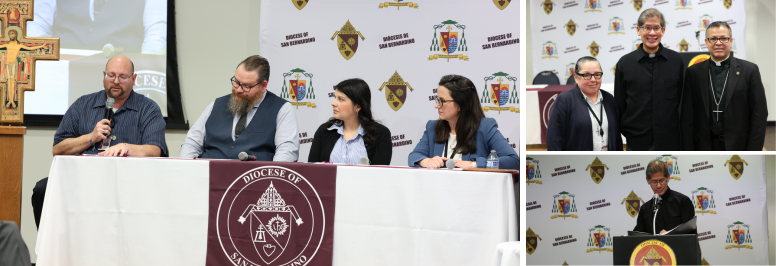
Speaking to a group of nearly 300 pastors, Catholic school principals and those in catechetical and youth ministries, Father Ricky Manalo, sP, described two competing viewpoints about the use Artificial Intelligence (AI) in the Catholic Church.
“One is that AI is the future and we should jump into it immediately. The other says, ‘wait, this is dangerous, let’s keep it out entirely,’ ” said Fr. Manalo, as he introduced a series of talks on AI at the Combined Vicariates Meeting held at the Diocesan Pastoral Center on Feb. 26.
He then suggested that neither of those perspectives is right. “The Church has another instinct,” he said. “Discernment.”
Indeed, Fr. Manalo’s reflections called those in attendance, which also included hundreds watching the meeting livestreamed on YouTube, to view AI through the lens of their Catholic faith. One talk outlined seven discernment frameworks for looking at and utilizing AI. The starting point, he said, was the framework of Human Dignity and Irreducible Encounter.
“The human person possesses a dignity that is not earned, not optimized, not updated and not programmed,” Fr. Manalo said. “God created us in His image.”
Several who attended the meeting said they related strongly to this first and fundamental framework outlined in the talk.
“It’s a confirmation for me that the personal relationship cannot be replaced by AI in my ministry,” said Belle Villaverde, a Confirmation catechist and youth minister at St. Elizabeth Ann Seton Parish in Ontario.
The other discernment frameworks presented by Fr. Manalo were:
• education and formation
• human agency, governance and responsibility
• truth, creativity and the integrity of meaning
• work, rest and human flourishing
• ecology and the protection of our common home
• our relationship with God
Many of the frameworks were drawn from Antiqua et Nova, the Vatican document released last January on the relationship between human intelligence and artificial intelligence. Fr. Manalo, a professor at Santa Clara University also known for his excellence in musical liturgy, wrote the introduction to Antiqua et Nova. He shared that his appearance at the Combined Vicariates Meeting marked his sixth visit to the diocese. He was a keynote speaker at the Diocesan Asian Pacific Islander Day in 2019.
The Combined Vicariates Meeting also served as an opportunity for members of a Diocesan AI Committee formed late last year at the direction of Bishop Alberto Rojas to be recognized. Four members offered a brief sharing on how they are using AI in their ministries: Dr. Amanda Alexander, Director of the Department of The Ministry Formation Institute, described her use of AI in faith formation ministry, including research of Church documents through the app Magisterium AI, and using AI as a “thinking partner” in preparing age-appropriate presentations and lesson plans.
Livier Mora, Director of Communications at The Holy Name of Jesus parish in Redlands, described a variety of AI uses, from drafting communications to translating documents for different cultures in the parish, brainstorming ideas, and improving clarity in announcements.
“These are supportive tasks not pastoral replacements,” Mora said. “It is important to emphasize AI is never the final voice.”
Jonathan Keck, Dean of Academics at Aquinas High School, shared that AI has already challenged traditional teaching practices such as assigning reading and writing homework. The school has a tiered system for assignments that designates the manner in which students may use AI, from research only to an entirely AI-generated project.
Diocesan IT Network Administrator Anthony Devlin provided insights on what happens to information that is provided to an AI app, from the standpoint of privacy and confidentiality. “When we put stuff in ChatGPT, the free version, anybody can reference that data. Your data gets extracted and added that AI’s learning algorithm.”
Fr. Manalo followed the panel discussion with a final presentation that demonstrated literally how AI can be used in different Catholic pastoral contexts. He prompted ChatGPT to draft prayers of the faithful for Mass, parish bulletin announcements and scripts for pastoral conversations. Later he asked ChatGPT to create a poem out of Antiqua et Nova, which appeared on the screen in seconds. “Not bad, but a little scary,” Fr. Manalo quipped.
Growing concerns about the impact of AI on the ecology surfaced in during Devlin’s presentation as he detailed the amount of energy and resources, including water, needed to power AI data centers. This was expressed in some comments of those watching the meeting on YouTube and in a question posed by one of the attendees at the close of the meeting.
“Is it worth it to create a lesson plan, or for a town to have potable water,” asked Jocelyn Cortez, a parishioner of St. John the XXIII in Fontana.
Many of the insights and practices shared by Fr. Manalo will be contained in “The Catholic Handbook on AI: Promise, Prudence and Pastoral Wisdom,” a book he plans to publish in 2027. Locally, the Diocesan AI Committee will continue to craft a set of AI Best Practices and Guidelines for the use of AI in ministry, and Catholic values by which all AI use should be measured and discerned.
Bishop Rojas, in his closing remarks, offered a summarizing thought on AI.
“It’s not going to go away. We either use if for good, or we let other people use it for [evil].”