

05/01/2026
By Sister Kathy Schneider, ODN
Through the centuries of religious life in the Church, expansion of a given community often is the result of a crisis. The history of the Order of the Company of Mary Our Lady over its 400+ years has often resulted in growth in new lands. Wars and government oppression in Mexico exemplify this type of expansion as the instability and danger resulting from the Mexican Revolution (1910-1920), the passing of the anticlerical laws known as Ley Calles in 1926 and the resulting Cristero Rebellion (1926-1929) required that the sisters flee across safer borders, in this case, the United States and Cuba.
The government seizure of three houses of the Order in February 1926 served as the catalyst that led to the decision to flee. The vice-provincial, M. María Cuesta, had already begun making plans but now they needed to be implemented even more quickly when she received word that government representatives were heading to the novitiate to confiscate the building. The novices and postulants were quickly sent into hiding at a nearby house owned by the family of M. Dolores Villela. Some of the young women chose to return to their families while those who chose to continue their formation in the Order packed a few belongings, removed their habits and, along with three fully professed sisters, prepared for the train that would take them to the U.S. They arrived at Eagle Pass, Texas on July 20, 1926. Future groups would make a similar trek to safety within the next few years.
While the sisters waited in Eagle Pass with the Sisters of the Good Shepherd, MM. Mercedes Barceló and Isabel Aceves departed Texas for Arizona to meet with the Bishop of Tucson, Daniel James Gercke, and to visit the town of Douglas. The sisters chose the small border town because M. Barceló had relatives there who offered the use of a house. Unfortunately, it was far too small for their numbers.
Moreover, the pastor, Fr. Ferdinand Rouselle, initially refused to support the arrival of a second religious community in the town, stating it was too small and the Loretto Sisters were already there. Eventually the pastor relented and offered the use of an old hotel that the parish owned. The remaining group left Eagle Pass and arrived in Douglas on August 6, 1926. Accounts describe the hotel as quite run down. The sisters spent days cleaning the rooms and convincing the numerous rodents to take up residence elsewhere.

In 1928, it became clear that the novitiate’s sojourn in Douglas would need to become more permanent. M. Ana María Serrano, the vice-province’s financial administrator, arranged for the purchase of a house on 10th Street, previously owned by Burdett and Carlota Packard. The coming of the Great Depression, however, made it impossible for the sisters to pay off the loan and thus began the greatest struggle the nascent community faced. Under constant threat of foreclosure, the sisters sponsored raffles, made hosts for Mass and offered classes in sewing and Spanish. They had opened a small kindergarten soon after arriving, but with the Depression, many families could not pay the low tuition. Despite their situation, the sisters were determined “to receive the children in the Kinder for whatever the families could give.”
The economic situation of the house impacted the community’s day-to-day existence from its earliest days. Not only was the community in debt to the bank, but often to many of the businesses in town for necessities such as medicine, cloth for the sisters’ habits, and house repairs. Poverty was also evident in their diet. In a letter from M. María Cuesta, she expressed concern that oatmeal, beans and flour tortillas made up most of the community’s meals. The generosity of Bishop Gercke, Father Rousselle, the Sisters of Loretto, and donations from the Knights of Columbus, alleviated the precarious financial situation. Eventually, donations of food from Douglas residents and receiving fruits and vegetables that had not sold in local stores helped to keep food on the table.

The Douglas community also directed many of the catechetical programs in the area. Their involvement increased in the mid-1930s when Father Rousselle requested that the sisters take over the program of the parish. The growing population of immigrants from Mexico found a Church unprepared to minister to their needs. All the early foundations of the Company of Mary in the United States worked to address this situation. Soon the sisters organized classes for the children. Part and parcel of the instruction was reinforcing traditional Mexican expressions of faith such as enthronements of Mary, Las Posadas, religious processions and fiestas to celebrate various saints’ days. These activities helped validate a culture intertwined with their Catholic faith. The Company of Mary became an integral presence in Douglas for the next ninety years.
another group traveled to Fresno, California. Bishop John MacGinely, concerned for the welfare of the Spanish-speaking population in his diocese, sought to apply innovative ideas to reach the many families spread throughout the agricultural towns in the San Joaquin Valley. Along with other religious communities, the sisters participated in an extensive, well-organized catechetical program.
The conditions were quite different from what the sisters had ever experienced causing them to feel they were truly in mission land. The range of outside temperatures, rain, fog, less-than-ideal teaching locations and the miles between centers made the ministry most challenging. The sisters bore the infamous heat of the valley in wool habits with starched headdresses. The distances were made easier when a benefactor donated a car for their use. Christened “Lestonnac”, the car greatly reduced the hours spent walking, taking trolleys and getting a lift from area volunteers.
Locations of the classes ranged from the yard of a willing family, the grounds of the local Catholic Church, to vegetable crates under trees in the fields. During the height of the grape or fig harvest, the sisters went out into the field encampments hoping “to make some small catch of children” before the families moved on to the next harvest location. The program was so successful that by 1934, the sisters taught some 1,520 children.
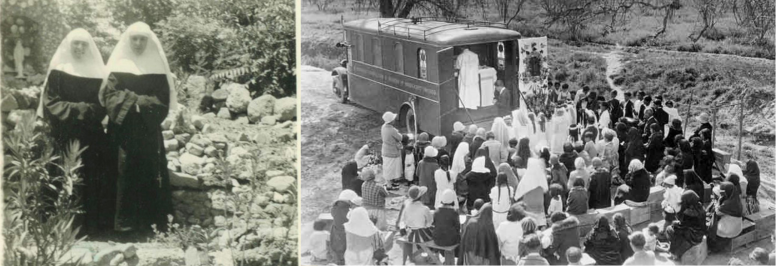
Since it was nearly impossible for many families to attend Mass at local parishes and chapels, the catechists decided literally to take the Church to them. Thus began an adaptation of the use of the ‘chapel-cars,’ an idea that seems to have had its origins in the chapel railway cars used to minister to railway workers and small towns along the route. A bus was customized to allow for a mobile rectory and chapel. Named “Santa Teresita” the bus doors opened in the back to reveal a small chapel.

Although catechism was the primary ministry, the sisters engaged in a wide range of outreach programs. These activities included summer day camps, home visiting, clubs and classes for mothers where the sisters conversed with them about life and faith while teaching sewing and other hand crafts. Home visits provided opportunities to ensure children were baptized, strengthen adults in the faith and, for those who had not done so, convince couples to have marriages blessed. The sisters believed that the ministry to parents, above all the mothers, was essential to the faith of the entire family, helping ensure that the religious instruction the children received would be reinforced in the home.

In the first two decades of the Company of Mary’s presence in the U.S., it expanded into Los Angeles where it opened early childhood centers, assisted in diocesan catechetical programs and even became part of the baseball Dodger’s history of Chavez Ravine. The sisters there served as the primary pastoral ministers in the small parish of Santo Niño in the Palo Verde neighborhood within the ravine. A planned housing project resulted in the destruction of the neighborhood through eminent domain. When the project collapsed, the Dodgers were invited to purchase the land and move the team to Los Angeles.
From the 1950s on, foundations began in Albuquerque, New Mexico; Tustin, California; and finally, in 1995, the Company of Mary moved into the Diocese of San Bernardino where the community established a retreat center and the Saint Jeanne de Lestonnac preschool and kindergarten that eventually expanded from preschool all the way to 12th grade.

As we celebrate the centenary of the Order’s crossing the border into an unknown future, let us also remember the thousands who continue to search for safety and better lives for their children. The challenges inherent in learning a new language and adapting to the different customs and bureaucracies in the U.S. required that the sisters develop great fortitude. They had to depend on help from many diverse quarters and ultimately to trust in the Lord’s providential care. This is reflected in early letters where both the pain of being a refugee and yet profound trust in the Lord are both evident. May the words found in the 1927 letter from M. Dolores Lozano inspire the same faith in Our Lord:
I am resigned and at peace because…I came in obedience and God knows what this cost me. I say to Our Lord, ‘Look, I did not seek this, I am here to do your holy will and so you are obliged to help me in all. I trust in what you have done and will do.’ I am not in my homeland and am a foreigner everywhere, [yet] heaven is an equal distance from here or from there. (M. Dolores Lozano, 1927)

Sister Kathy Schneider, ODN, is part of the administration team at St. Jeanne de Lestonnac High School in Temecula. This article is adapted from an earlier work “Called to New Lands: The Order of the Company of Mary Our Lady in the United States” (2016) written by Sr. Kathy Schneider, ODN.