

By Dr. Ruben Barron
As four Catholic families, from different ethnic backgrounds, prepared to celebrate Jesus’ birthday, each took time to reflect on the most endearing and enduring Christmas holiday traditions passed on from their ancestors. They found the special time of the year ideal for recalling how they were all taught and loved as children and how quickly it befell on them to preserve and convey their faith and family values. They felt societal changes occurring at increasingly rapid speed, made it more difficult, and perhaps more necessary, to transmit long-held Christmas ethics with their ability to foster family bonds across generations.
Marcelino “Chico” and Liliana Garza were married 25 years ago in Holy Family Catholic Church in Hesperia where they remain active. Both had previously raised their own family. Raised in Mexico, her family’s primary focus was on Jesus’ birth. “On December 16, we would put up a Christmas tree, start a novena praying the rosary for nine days and then lay Jesus on the Nativity,” she said. The spiritual traditions extended to attending Mass and hosting family and friends for tamales. She raised her own family with the same traditions.
Chico grew up in Texas. Life was not easy but the family found imaginative ways to live life and celebrate Christmas. Family gatherings, over homemade meals were central to all celebrations. “During Christmas, we would pop corn and string it several times around a tree, not necessarily what we think of as a Christmas tree,” he shared.
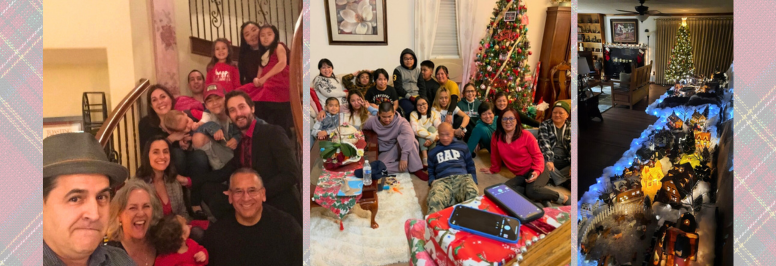
Since their children have grown and moved away, the family gathers to celebrate Christmas as the opportunity arises. Maintaining a treasured tradition, the Garzas have constructed a sparkling Christmas village inside their home for every visitor to enjoy a Latino Nativity during the Christmas season.

Antonio and Nelia Avila are parishioners of St. Elizabeth Ann Seton in Ontario. They were both born in Portugal. She was only nine years old when her family immigrated to the United States and still cherishes warm memories of Christmas in her native country.
“We would prepare for the holiday by decorating our home. My father would gather green brush, filling our home with fresh smells of pine,” Nelia said.
The season progressed with extended family gatherings sharing meals and intimate conversation. Nelia recalls the delicious smells and warmth of the country’s traditional bacalhau (cod) fish. For nine days before Christmas, friends walked the neighborhood filling the cool nights with joy and Christmas carols. On Christmas Eve, before going to bed, children set their shoes for Santa Clause to fill them with candy, cookies and other treats.
The Christmas traditions learned in childhood in Portugal were passed to their children born in the new country. Nelia’s favorite is having family gather to share meals and their faith by honoring baby Jesus. After all, Christmas means, “love, peace, and faith,” she said.
Agustin and Mila Lopez, parishioners of Holy Innocents Catholic Church in Victorville, were born in the Philippines. They left their native country as young adults for the United States, where they raised their own children. With no other relatives nearby, they relied on the Filipino church community to resume the traditions they had learned as children.

Mila recalled caroling around the neighborhood as a child and seeing bright parols (star-shaped lanterns) as reminders of the Star of Bethlehem adorning homes. The main tradition in her former country and her new home was the Simbang Gabi (Night Mass) celebrated December 16-24. As the Filipino community blossomed in the high desert, people began gathering to celebrate the highly spiritual aspect of Christmas. Mila shared, “We congregate in six or seven different local parishes for nine days of prayer and fellowship.”
Among the various flavorful food traditions, lechon baboy (whole roast pig) is the most popular on Christmas Eve and Christmas Day as a sign of truly special celebration. Lechon is a centerpiece and symbol of abundance, hospitality and celebration. It was something the couple first experienced in the Philippines and has continued to share with friends and neighbors and their own grown children when they visit from Arizona and Nevada.
Silvana Cavazos, a parishioner of St. Peter and St. Paul, Alta Loma was only two years old when her family immigrated from Italy to the United States. From her earliest memories, she recalls large family gatherings filled with laughter and good food shared among several generations of family members. Home was filled with joy, prayer, food and games.

“While the children fixated over their shiny new toys, adults were absorbed in the popular Italian card game, Scopa,” she recalls.
Over the years, while aunts, uncles, cousins and other extended family members remained in Italy, keeping time-honored Christmas traditions bridged both time and distance, holding family and friends together. Cavazos, now retired with children spread all over the country, no longer attends midnight Mass on Christmas Eve. “It’s hard to stay up late when I’m used to getting up early. I wait until Christmas day for early morning Mass,” she said.
As these four families have experienced, keeping Christmas traditions matter. They help us remember who we are and create connections across generations. They make us feel part of a long story. Simple and profound acts like setting up the nativity link us to Jesus and all of humanity. That connection gives us stability in a changing world, and encourages gratitude, generosity and spiritual grounding. Feliz Navidad! Feliz Natal! Maligayang Pasko! Buon Natale!
Dr. Ruben Barron is a spiritual director and freelance writer based in Yorba Linda.