

By Natalie Romano
Marcus Magana took his role seriously.
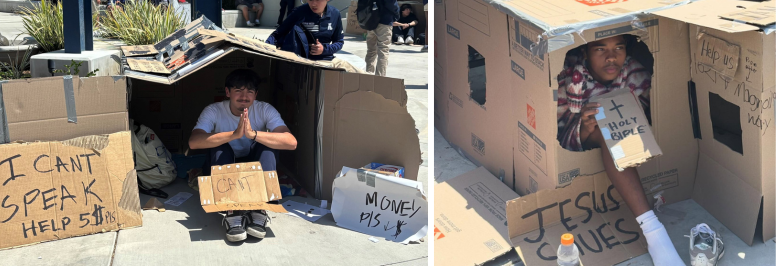
He didn’t eat breakfast; he didn’t eat lunch, then he sat in the hot sun next to a cardboard hut…all in order to portray a child that is homeless.
His character was one of many depicted by students during the “Poverty Awareness Project” staged at Aquinas High School in San Bernardino on April 30th.
“You have to get hungry to know what it’s like, at least a little…I know I have food at home, but they don’t know the next time they’re going to eat,” said Magana, Aquinas student. “Before this assignment, I didn’t know there were so many hungry kids out there.”
Some 50 theology students created the homeless encampment to share what they’ve learned about poverty and the calling of the faithful to respond to it - all based on Catholic Social Teaching (CST).
Underclassmen touring the exhibit engaged with seniors portraying hardships like hunger, mental illness, or being homeless despite having a job. Additionally, student guides provided factual information about the causes and effects of poverty. “Theology: Faith in Motion” teacher Chris Estrella was pleased with the results.
“The overwhelming response from our 500 students who came through was that they saw and heard things they had never known or thought about regarding poverty,” stated Estrella, who is also the Assistant Director of Campus Ministry. “It opened up new branches of thinking for them and these portrayals represented the real faces of suffering out in the world.”
In order to transform the school courtyard into an encampment, students erected makeshift shelters, wrote signs asking for food and wore torn clothing. Clutching a doll, Mexyica Clesceri played a mother who lost her home due to medical bills. Her “station” displayed statistics about needy families, stating they make up about 30 percent of the homeless population with the primary cause being the lack of affordable housing.
“They are trying their best but a lot of the time that just isn’t enough. This world is expensive,” said Clesceri. “I’m a lot more motivated to help, to put a smile on someone’s face.”
Another station depicted the dangers of life on the street. Noah Martinez played “Christian,” an unhoused person who could not hear or speak. Martinez says that he learned that this leads to additional risks for someone already in a challenging situation due to disability.
“They may be more vulnerable to theft, abuse or exploitation because they can’t yell for help,” described Martinez. “They can only communicate through American Sign Language and not many people know that. So, it is a real struggle.”
In conjunction with research on poverty, the theology students reviewed the seven themes of Catholic Social Teaching. These guidelines, rooted in Scripture, show us how to live out our faith in a modern world. The first and most basic principle proclaims all life is sacred and has inherent dignity. For this project, particular emphasis was placed on the “Preferential Option for the Poor and Vulnerable” which states that a society is judged on how it treats those who are most in need.
That pillar was echoed by diocesan employees who visited the encampment. Sister Chilee Okoko, D.M.M.M., Teresa Rocha and Yolanda Madrid listened to the students, asked questions then shared insights based on their ministerial experience. Sr. Okoko, Director of the Diocesan Department of Life, Dignity and Justice, told the theology students that one day they could be the answer to someone’s prayers.
“You are that help, God is sending you. If you just give [a homeless person] a glance and walk away then God has no instrument,” she explained. “We are our brother’s keeper, our sister’s keeper. This is the social mission of our Church.”
Estrella says many students were “shocked” by the idea of acting homeless but for a few the concept was not so foreign. Magana says he has struggling relatives including a kind aunt who used to skateboard with him.
“I feel really bad because my aunt is unhoused and I haven’t heard from her in a while,” shared Magana. “I love my aunt and it’s kind of hard.”
Even if students don’t have direct experience with homelessness, they certainly see it, says Aquinas Principal Dr. Amanda Egan. She was a student at Aquinas 26 years ago when a similar faux encampment was built. The project was also repeated in 2010. She says since then the homelessness crisis has only grown, but so has the school’s commitment to social action.
“Every single day when our students drive into school they’re witnessing the homeless epidemic,” said Dr. Egan. “They need to learn about it on a deeper level, why these people are homeless…what would Jesus do in this situation? We’re forming servant leaders in the light and truth of the Gospel.”
Visitors were asked to leave a small donation in jars placed around the encampment. The money was then given to charity.
After roasting in a small cardboard box all afternoon, Madison Vilches says she’s gained a new perspective.
“It really puts me in the shoes of an actual homeless person and how they might feel, and I feel fortunate to have a home.”
__________________________________________________________________________________________
Natalie Romano is an award-winning freelance writer based in Southern California.