

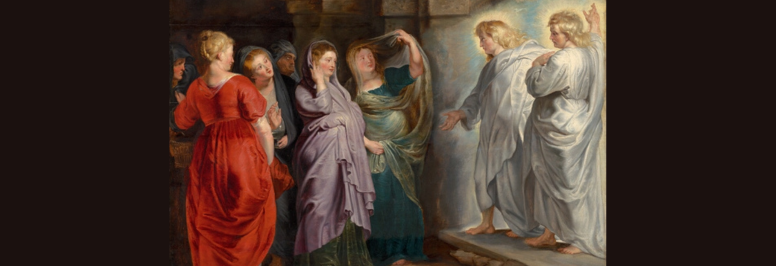
Recently I watched a rebroadcast of one of Sister Wendy’s art talks. Sister Wendy Beckett was a British Carmelite nun who made PBS documentaries in the 90’s about Western art. In the one I viewed, she commented on a painting by Peter Paul Rubens called The Holy Women at the Sepulcher. She pointed out the different expressions on the faces of three of the women. Here’s what she said, with a bit of tweaking from me: The first woman with veil lifted is looking skeptically at the two angels, as if to say with Archie Bunker, “Don’t tell me that!” The second one looks as though she is thinking, trying to see if this new idea might be true. The third looks joyful, as if she is saying a big “Yes!”
Resurrection faith is somewhat like the three women. Skepticism about Jesus’ Resurrection abounds in post-Easter scriptures. The disciples were slow to believe even though the women tried to convince them. Thomas, who missed an appearance of Jesus in the upper room, had to see for himself by touching the risen Jesus’ wounds. Two disheartened disciples on the road to Emmaus thought it was “all over” until they met a stranger. After Pentecost, despite the impressive preaching from Peter and the witness of many who had seen and heard Jesus, most people did not believe in a risen Jesus. Like us, they knew what happened to dead bodies. Like us, they experienced the impenetrable curtain that falls between us and our beloved dead. And their Jewish faith did not help either; it did not have a deep scriptural tradition of belief in life after death.
The second woman in the painting seems to be thinking. Like us, she is trying to figure out if she could possibly believe. Once unintentionally I reduced a couple college freshmen to tears in an Intro to Philosophy of Religion class. I divided the class into two groups. One group was to prove to the other that their mother loved them. They were not successful. The skeptics won, thus the tears. Of course, we then went on to talk about the role of subjective experience in belief.
Beginning in second half of the 19th century, an important shift called the “turn to the subject” occurred in philosophy. Instead of only considering data and universal laws governing reasoning or science, philosophy added human subjective experience as a factor in coming to know and understand a truth. And theologians began stressing that sustained reflection on our own inner subjective experience leads to deeper understanding of and support for our faith beliefs.
Now about Resurrection, both Jesus’s and ours. When we reflect on our subjective experiences of living on this planet, of interacting with others, of learning and desiring, we can see indications that individual lives have a future beyond our deaths.
Here’s one of many examples: Life itself is about shaping the future, when you think about it. We fight hard to shape the present time because we want that same for our children who will live after us. We shape words into laws and found institutions and nations to make the future more predictable. We commit to or covenant with others who will help us do this and to accompany us when the going gets tough. Even more amazing, we believe this future, making is really possible! Where does that unbelievable assumption come from? It seems that an innate aim toward the future is something built in to us. The late, great 20th Century theologian Karl Rahner, SJ, spoke of a “supernatural existential.” He meant a graced capacity in us that helps us hear the still small voice of the God who has always been and always will be creating. This God graces us and spiritually energizes us to invest ourselves in the future with him. In Jesus’ words, it’s about partnering with the Spirit to bring about the Kingdom.
Another subjective experience that indicates our individual lives have a future beyond our deaths is that others live on in us. They live in our consciousness and memories, alive in us beyond the time and space in which they had lived. They were our “influencers,” directing us to goodness, truth, and beauty. The good we do will in turn influence the future through others who have known us, giving the future more potential toward good because we have lived. Our God who holds all creation in his hand will hand on the goodness of our lives as a gift to the future through the Risen Christ.
And so, we come to the third woman, the one who is joyful and accepting of the truth of resurrection. Eventually faith requires that we trust our inner experience, as well as other proofs like revelation and the traditions of our faith family. We must “call the question” and conclude that our “proofs” are reasonable enough and sufficient enough to live by. We make what is called “a leap of faith (Søren Kierkegaard),” knowing that even in science, proof is never absolute, only probabilistic. The students who needed to believe their mothers loved them were not in touch with their own subjective experience of being loved and so were defeated by doubt.
We live in a world of change, and so, our words about matters of faith are evolving. And also, as Catholic theology teaches, the best words and ideas can never adequately convey for us the God whose immensity is like a horizon toward which we travel but never arrive. At a certain point we must say “yes” to faith, embracing with joy what we know through our subjective experience of God, and with a graced inner certainty and trust that it is OK not to completely understand. Only then can we believe in, rest in, and adore the Risen Christ.
Sister Mary Garascia, PhD (Theology), is a member of the Sisters of the Precious Blood of Dayton, Ohio, where she now resides. Until recently she lived and ministered at The Holy Name of Jesus in Redlands. You can follow her weekly Sunday scripture blogs at PreciousBloodSistersDayton.org.